
Pipe Ramming in Bexleyheath
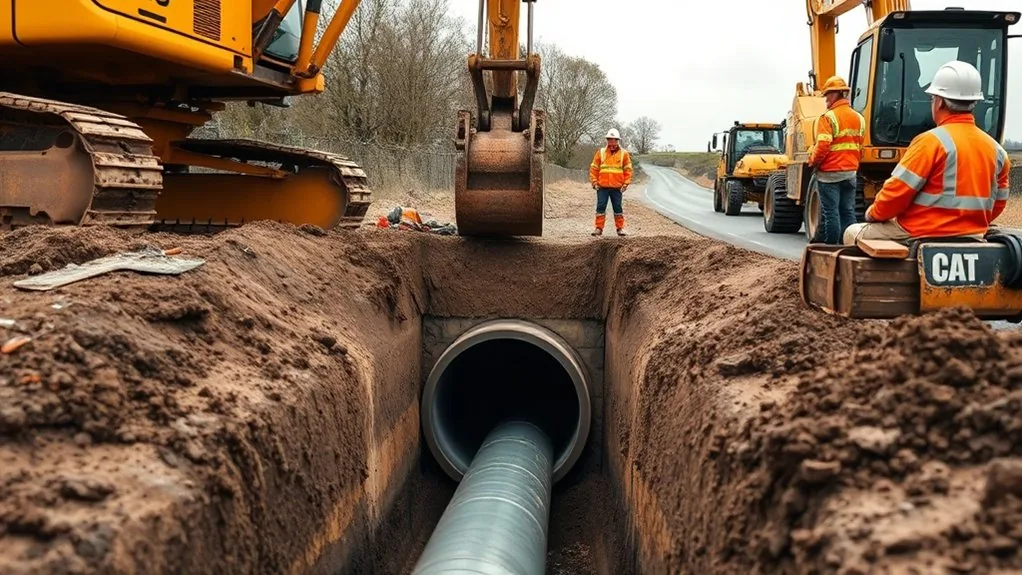
When you need to install steel casings beneath roads, railways, walls or building foundations without disrupting the surface, traditional open-cut excavation isn’t always feasible.
Pipe ramming offers a precise, controlled solution that minimises settlement and protects existing services.
Contact us for a fast quote or emergency callout in Bexleyheath.
When you talk about pipe ramming, you’re referring to a trenchless installation method that uses a pneumatically driven hammer to push (ram) steel casing horizontally through the ground without rotating it. You install the casing by direct impact at the rear, transmitting energy through the pipe to advance it through soils.
You typically use open-ended steel casings, then remove displaced material by augers, air, or water once the casing reaches design length. From a historical context, pipe ramming evolved from pile-driving practice, formalised through standards and best-practice guidance for crossings beneath roads, railways, and structures. Its environmental impact is comparatively low: you minimise surface disturbance, vibration transmission is predictable, and you reduce spoil generation, aiding compliance with environmental and construction-management plans.
Understanding how pipe ramming works is only half the equation; you also need to know the ground and project conditions that warrant its use. You’ll typically specify pipe ramming when you must drive steel or other robust pipe material under assets that can’t tolerate settlement or vibration from open-cut or bore failure.
You’ll most likely need pipe ramming when:
When you commission pipe ramming in Bexleyheath, you’ll follow a defined step‑by‑step ramming sequence that uses specialist hammers, casings, and cutting shoes designed to meet recognised installation standards. You need to understand how these tools manage soil displacement and spoil removal so the pipe advances without unacceptable heave, settlement, or damage to adjacent assets. Throughout the operation, you’ll rely on accurate setting‑out, real‑time monitoring, and control systems to maintain line, level, and compliance with project specifications.
Although pipe ramming systems can be configured in various ways, the installed sequence follows a consistent, standards‑oriented workflow: you position and secure the launch pit and guide rails, align the steel casing to the design line and grade, connect the pneumatic hammer to the rear of the casing, and then initiate controlled impact blows to advance the pipe through the ground. You monitor penetration rate, line, and level, adjusting energy input to prevent ground heave and minimise environmental impact, especially under roads and sensitive structures.
You periodically stop ramming to check casing integrity, looking for early signs of pipe corrosion or ovality that could compromise long‑term performance.
| Stage | Key Control Focus |
|---|---|
| Site setup | Stability, exclusion zones |
| Alignment & ramming | Line/grade, blow energy |
| Verification checks | Welds, coating, corrosion risk |
Because each phase of pipe ramming depends on tightly controlled forces and alignment, the process relies on a coordinated suite of specialist equipment: high‑energy pneumatic ramming hammers matched to casing diameter, engineered launch frames and guide rails to maintain line and grade, robust casing handling systems (cranes, lifting beams, rollers) for safe positioning, and calibrated air compressors and lubrication systems to deliver repeatable impact energy.
You’ll specify hammer size, stroke frequency, and air delivery to conform with project tolerances and asset protection requirements. You’ll also verify structural capacity of launch frames against imposed ramming forces and buckling risks. Rigorous equipment maintenance is essential: you’ll implement scheduled inspections, non‑destructive checks on lifting gear, and air system servicing. Safety protocols must govern pinch‑points, stored‑energy release, exclusion zones, and noise exposure.
As the ramming hammer drives the steel casing forward, the cutting edge displaces soil laterally into the surrounding ground while simultaneously compacting a soil plug inside the casing that you’ll later remove as spoil. This controlled displacement creates localised soil compaction around the pipe, improving bedding and reducing void risk beneath roads, walls and buildings in Bexleyheath.
You’ll plan spoil removal in line with project specifications and environmental regulations. Depending on diameter and drive length, you may use augers, air lances, or excavators to extract the compacted plug in stages, preventing overstressing the casing. Segregate, quantify and classify spoil for appropriate reuse or disposal. Throughout the operation, you’ll maintain clean internal bore conditions to assure the installed casing meets hydraulic and structural performance standards.
How do you keep a high‑energy, percussive installation method like pipe ramming precisely on line and level beneath Bexleyheath’s roads and structures? You start with calibrated survey control, tight tolerances, and verified datum points. You establish design alignments, then translate them into on‑site setting‑out pins and laser references.
During ramming, you maintain measurement accuracy using total stations, digital levels, and laser targets fixed to the pipe. You implement real time monitoring of pipe position, penetration rate, and hammer energy, logging deviations against pre‑defined trigger values. You also track surface settlement markers and adjacent asset movement. If readings trend towards limits, you adjust hammer frequency, lubrication, or guidance frames. This disciplined control regime keeps the drive compliant with specification and asset‑protection standards.
While traditional open-cut excavation remains common for installing underground utilities, pipe ramming offers a structurally controlled, trenchless alternative that drives steel casings through the ground using percussive force, minimising surface disruption and maintaining alignment in challenging soils. When you compare pipe ramming with Historical methods of excavation, you’re essentially weighing surface access against subsurface precision and control.
Traditional excavation requires full-width trenches, temporary works, and extensive reinstatement, with higher Environmental impact from spoil removal, traffic management, and noise. Pipe ramming confines works to launch and reception pits, reducing interface with existing pavements, foundations, and buried assets. You’re able to maintain cover, structural integrity, and compliance with asset protection standards, particularly beneath highways, railways, and building footprints.
Because pipe ramming is inherently trenchless and percussive, it delivers a combination of structural reliability, programme certainty, and reduced surface impact that’s difficult to achieve with open-cut methods in Bexleyheath’s mixed ground conditions. You gain a controlled installation route, high positional accuracy, and minimal disruption to existing assets, even where live roads, rails, or sensitive structures are present.
You also improve compliance with safety considerations and Environmental impact objectives, as there’s no open trench for operatives, traffic, or pedestrians to negotiate.
Across Bexleyheath’s built environment, pipe ramming provides a robust trenchless option for both domestic and commercial schemes where new or replacement services must pass beneath existing infrastructure without open-cut. You can install steel casings for water, gas, power, and communications beneath roads, driveways, rail lines, and foundations while maintaining surface operation and structural integrity.
You’ll typically apply pipe ramming where alignment tolerances are moderate, ground is variable, and you need predictable drive lengths with minimal Environmental impact and disruption. Design should align with relevant British and EN standards, addressing loading, corrosion protection, and reinstatement.
| Application Type | Typical Uses |
|---|---|
| Domestic | Driveway crossings, garden services |
| Commercial | Car parks, service yards |
| Infrastructure | Highways, rail corridors |
| Industrial | Plant utilities, process lines |
Safety considerations must govern planning and execution.
Whether you’re working on a small driveway crossing or a strategic utility corridor, our pipe ramming service in Bexleyheath delivers steel casing installations that are engineered to current BS and EN standards, with a focus on structural performance and service life. You get accurately aligned, depth-controlled drives that maintain cover, protect existing assets, and provide a reliable host pipe for future utilities.
We assess ground conditions, surcharge loads, and adjacent structures to define casing diameter, wall thickness, and grade, referencing both current standards and relevant historical practices to anticipate ground behaviour. Hammer energy, drive sequence, and lubrication regimes are specified to limit settlement, vibration, and environmental impact, particularly around highways, rail, and sensitive foundations across Bexleyheath’s varied geology.
From initial feasibility through final proving, you’re selecting a pipe ramming contractor in Bexleyheath that’s driven by engineering discipline, not trial‑and‑error. You get methodical constructability reviews, calibrated ramming sequences, and documented risk assessments aligned with current UK and EU standards.
You’re supported by rigorously audited safety protocols, RAMS packs tailored to your site, and operatives trained for high‑risk environments and constrained easements. We model ground conditions, structure clearances, and temporary works to minimise heave, settlement, and utility conflict.
You also benefit from procedures that reduce environmental impact: controlled working windows, noise‑attenuated tooling, and closed‑loop handling of arisings. Traceable QA records, accurate as‑built data, and coordinated stakeholder communication keep your programme predictable and compliant from mobilisation to demobilisation.
You’ll want clear, quantified answers on how long pipe ramming takes, whether it’s more cost‑effective than open-cut excavation, and if your specific location in Bexleyheath is covered. In this section, we’ll address these points using typical programme durations, cost comparisons, and defined service zones. This helps you assess feasibility, compliance, and budget alignment before committing to the method.
Although every project is different, pipe ramming durations are primarily governed by drive length, pipe diameter and thickness, ground conditions, and site access constraints. For typical utility crossings in Bexleyheath, you’ll often see active ramming completed within a few hours to several shifts, with additional time for setup, alignment checks, and demobilisation.
You’ll need to factor in geotechnical data, groundwater, and obstructions, as these can slow progress and require contingency time. Environmental impact and safety considerations also influence the programme: you must allow for noise‑restricted working hours, traffic management phases, exclusion zones, and inspection intervals.
A competent contractor will give you a schedule based on method statements, RAMS, and relevant standards, then refine it once site investigations are complete.
Often the right question isn’t simply “Is pipe ramming cheaper than digging?”, but “Cheaper over what distance, in what ground, and under what constraints?” In Bexleyheath, pipe ramming can reduce overall project cost where open‑cut trenching would trigger expensive traffic management, deep excavations, extensive reinstatement, or utility diversions.
When you run a rigorous cost comparison, you’ll assess plant, labour, material, traffic control, and reinstatement against the programme and risk profile. For short, shallow, unconstrained crossings, traditional digging may remain cheaper. However, as depth, surface value, and third‑party constraints increase, pipe ramming often becomes more economical on a whole‑life basis.
You should also factor environmental impact: less surface disturbance typically means reduced waste export, fewer vehicle movements, and lower carbon emissions.
Our pipe ramming teams cover the vast majority of Bexleyheath, including urban corridors, trunk roads, rail interfaces, and sensitive rural or coastal zones. You’re likely within our operational envelope if your works interface with highways, rail assets, major utilities, or strategic development sites.
Before confirming coverage, we review your exact location, access constraints, and ground investigation data. We then align the proposed methodology with local regulations, highway authority requirements, and utility owner standards. For environmentally sensitive areas, we assess environmental impact, vibration levels, and noise to guarantee compliance with planning and statutory obligations.
You’ll receive a project-specific feasibility statement confirming whether we can service your site, any mobilisation constraints, and what approvals or traffic management provisions you’ll need.
Yes, pipe ramming can be carried out during night hours to reduce traffic disruption. This is allowed if all night-time safety and environmental requirements are met, including proper lighting, noise control, and exclusion zones in line with local highway and health and safety standards. You must also ensure that method statements, risk assessments, and traffic management plans are updated for night work, with appropriate inspection, communication, and contingency measures in place.
You need a Section 50 street works licence and traffic management approval from Bexleyheath County Council for pipe ramming works. Method statements must be agreed with the council’s Highways team, and you must submit RAMS covering safety, environmental controls, and compliance with NJUG and CDM Regulations. If the works affect rivers or groundwater, Environment Agency consent is required, and planning or prior approval may be necessary for permanent structures. Utility search clearances and noise or vibration management approval might also be needed.
The pipe ramming process produces noticeable but controlled noise levels similar to heavy construction with occasional impact vibrations. Noise occurs as impulsive sounds during active driving cycles, usually limited to agreed working hours. Measures such as acoustic barriers, compliant plant selection, equipment maintenance, and careful control of ramming energy help reduce noise transmission to nearby homes and businesses.
Yes, there are limits on the weight and size of structures you can ram under. These limits depend on structural integrity assessments and equipment specifications, not a fixed maximum size. You must consider factors such as overburden depth, foundation type, load paths, allowable settlement, hammer energy, pipe diameter, wall thickness, and drive length.
Yes, existing underground utilities can be accurately located and protected before ramming starts. This is achieved by commissioning PAS 128-compliant surveys that use records, electromagnetic scanning, and ground-penetrating radar to map the services. A risk assessment is then completed to define exclusion zones and protection measures, supported by continuous depth checks, trial holes, and permit-to-dig procedures.
Ready to move from feasibility to implementation, you can request a pipe ramming quotation that’s tailored to your ground conditions, pipe diameters, and installation tolerances. You’ll receive a structured proposal detailing methodology, equipment selection, programme duration, and access requirements, with clear assumptions and exclusions.
Provide as-built drawings, utility records, any ground investigation data, and your preferred alignment so we can define the drive length, cover, and entry/exit pits accurately. We’ll also address pipeline safety, settlement risk, and Environmental impact, referencing relevant UK and Eurocode standards where applicable.
Your quote will specify unit rates, mobilisation costs, testing requirements, and reinstatement obligations, giving you a compliant, costed solution that’s ready to integrate into your wider project plan.